
By Elighton Emeka Okoye
Breaking: The Great Leapfrog — How AI is Rewriting Africa’s Economic Playbook NAIROBI & LAGOS — Decades ago, Africa rewrote the global financial playbook by bypassing landlines and traditional bank branches entirely, jumping straight to mobile money. Today, a far more radical shift is underway.
The continent is no longer just adopting global technology—it is utilizing Artificial Intelligence to completely skip legacy infrastructure, creating an agile blueprint for the future of developing economies.Economic analysts project that AI adoption could inject $1.2 trillion into Africa’s GDP by 2030, representing a massive 5.6% economic boost. Instead of building massive, slow-moving physical institutions, local innovators in West and East Africa are deploying nimble, cloud-based, and localized AI models directly to mobile screens. Let's look at how the region's main hubs stack up:
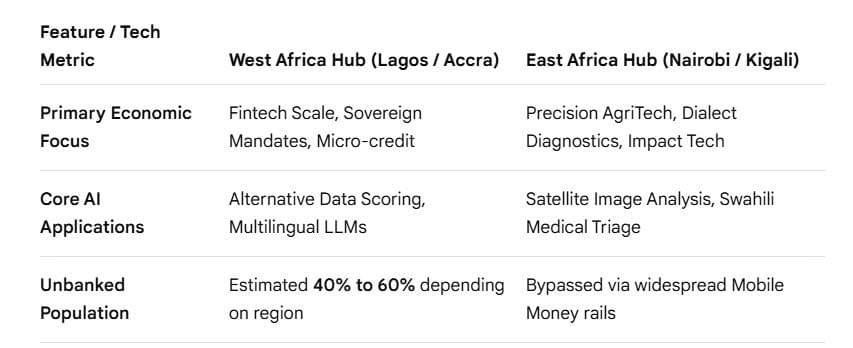
Regional Powerhouses: West vs. East Africa
The momentum of this tech revolution is concentrated within two dominant regional power corridors, each addressing structural challenges with hyper-localized software.
1. West Africa: Scaling Fintech & Sovereign Mandates
In Nigeria and Ghana, the focus centers on economic scale and national security. Nigeria—boasting one of the continent's largest tech ecosystems—recently launched its multilingual National Artificial Intelligence Strategy to accelerate domestic developer talent.

Meanwhile, West African fintech firms are deploying predictive AI algorithms to analyze alternative data, like mobile airtime purchases and digital merchant transactions. This completely bypasses traditional credit bureaus, instantly scoring and unlocking micro-credit for the region's massive unbanked population.
2. East Africa: Precision Agriculture & Dialect Diagnostics
Kenya and Rwanda have emerged as the epicenters for impact-driven AI. Nairobi's "Silicon Savannah" is heavily focused on AgriTech and healthcare.
Because traditional agricultural extension services are critically understaffed, East African startups use machine learning models to analyze satellite imagery and soil sensors. This yields real-time crop management advice delivered via basic SMS. In healthcare, where the doctor-to-patient ratio can be as low as 1 to 10,000, regional medical centers are deploying generative AI assistants trained in local languages like Swahili to triage remote patients.
Driving Authority: Expert Perspectives
"The West talks about AI in terms of convenience or existential risk, but in Africa, AI is a tool for foundational survival and economic acceleration," says Dr. Amina Osei, a prominent tech policy researcher based in Accra. "We don't have the luxury of waiting for legacy healthcare grids or legacy banking infrastructure to be built. AI allows us to construct the final digital destination today."
The core strategy for long-term sustainability rests on a single concept: Sovereign AI.
Industry leaders emphasize that Africa must move away from relying purely on Western or Asian tech infrastructure. Training models on local datasets and building indigenous Large Language Models (LLMs) that understand regional dialects are critical safeguards against digital colonialism.
"If global tech companies train models exclusively on Western data, those models will inherently fail the African user," warns Chidi Egwu, co-founder of a Lagos-based AI infrastructure startup. "Building sovereign AI ensures that our agricultural algorithms understand tropical weather patterns, and our healthcare bots understand local communities."
The Infrastructure Hurdle
Despite the rapid software iteration, a significant roadblock remains: the physical layer. The "leapfrog" effect is currently constrained by major infrastructure gaps:
The Power Grid Deficit: Reliable electricity remains a challenge, as AI compute workloads require consistent, heavy power.
The Cost of Connectivity: High-speed internet access remains expensive relative to average incomes in rural areas.
Data Governance: Fragmented data privacy laws across borders make regional scaling difficult for startups.
The current momentum, however, is undeniable. By treating unique structural challenges not as roadblocks but as clean slates for innovation, West and East Africa are proving that the next phase of global AI development will not just be built in Silicon Valley—it will be forged in Accra, Nairobi, and Lagos.

📩 Join the Next Tech Wave
Want to stay ahead of the curve on global tech shifts?
Subscribe to our AI News Insights Newsletter to receive deep-dive analyses, exclusive founder interviews, and weekly breakthrough updates delivered straight to your inbox.
👉 Subscribe to Starnok AI News Now
